Do you have what it takes to deliver a speech at the grand final of the ESU’s Public speaking Competition? Do this simple exercise to find out!
Giving a speech at the ESU’s Public Speaking Competition is not just a matter of reading something you have written, it’s about thinking about how best you will connect with the audience. Where will the emphasis be? Where will you pause? Will you play it straight, or for laughs? How much eye-contact will you make, and with whom – the spectators, the judges, your teammates? And lastly, how will you use your notes to best effect?
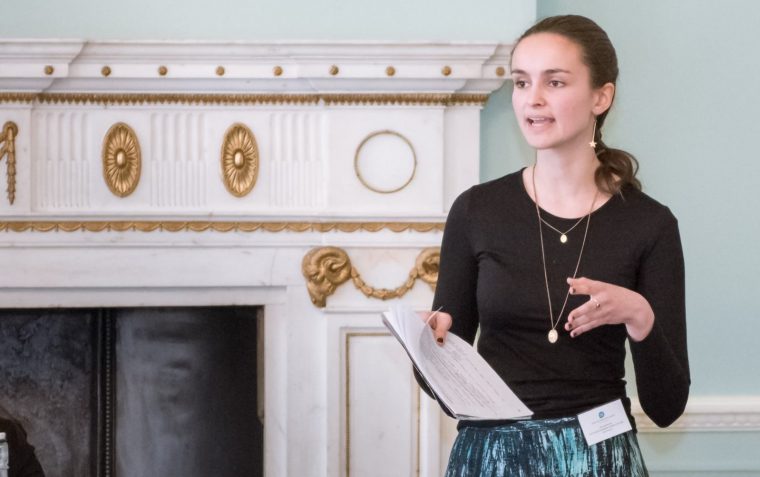
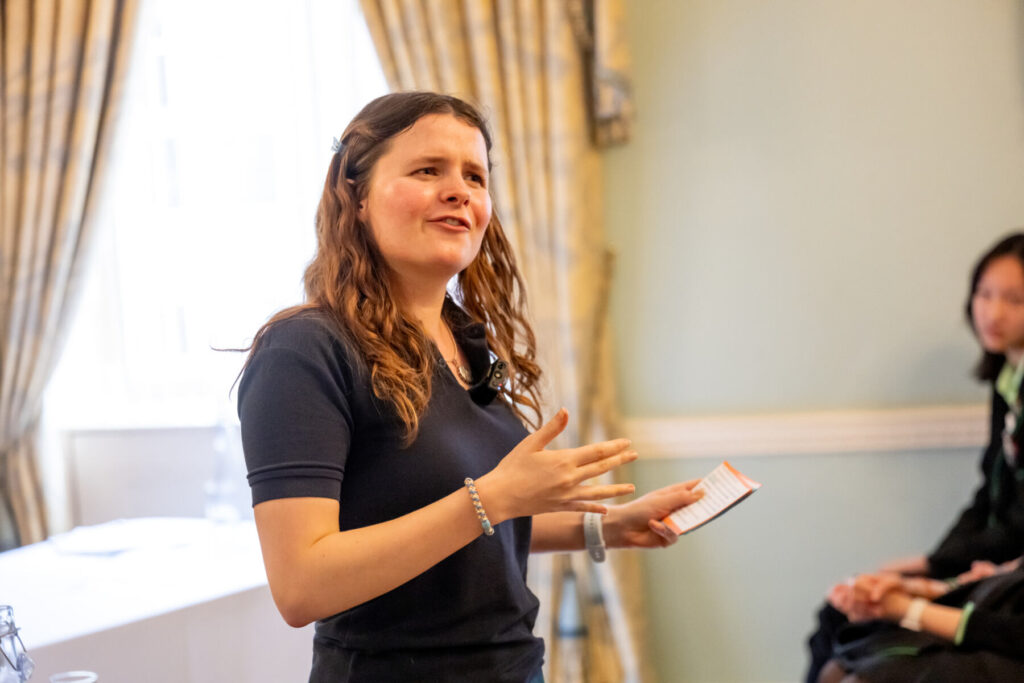
Two recent grand finalists from our PSC 2026 have kindly shared their speeches with us: Aayushi Talwar (King Edward VI High School for Girls) and Charlie Hagelthorn (South Wilts Grammar School), who won Best Speaker. Both are excellent examples of well-structured speeches, and both effectively delivered. Have a read and consider how you would deliver the speech – and then see for yourself how Aayushi and Charlie did it.
Do we value speed more than judgement? Aayushi Talwar (King Edward VI High School for Girls)
Imagine: a controversial event happens online and, within minutes, millions of people begin responding. Opinions spread faster than facts, reactions appear before understanding, and people rush to comment before they have even had time to reflect.
In a world defined by instant reaction, the real question is not what we say, but how quickly we are expected to say it. So perhaps we need to ask: do we value speed more than judgement? The philosopher Plato once observed that, ‘Wise men speak because they have something to say; fools because they have to say something’, suggesting that wisdom lies not in speed, but in thought.
Before we can answer that question, we need to ask what those words really mean.
Speed is the ability to respond without delay. Judgement is the ability to pause, evaluate and decide wisely.
Put simply, speed determines how quickly we act. Judgement determines whether we should act at all.
Modern life rewards speed visibly. Social media encourages instant reactions; twenty-four-hour news demands constant updates. We are expected not only to have an opinion, but to have it immediately.
Take the example of the 2022 Johnny Depp vs Amber Heard trial, where viral TikTok clips such as Amber Heard’s testimony shaped public opinion long before many people had engaged with the full courtroom evidence, illustrating how modern culture can reward immediate reaction over informed judgement.
This culture appears in classrooms too. Students who respond quickly are often perceived as more capable than those who take time to think carefully before answering. Yet the fastest answer is not always the most thoughtful.
As the saying goes, ‘The empty vessel makes the loudest sound’, suggesting that those with the least understanding are often the most outspoken. And perhaps modern society increasingly confuses speed with intelligence, and noise with understanding.
The consequences of this can be significant. During the COVID-19 pandemic, information travelled at unprecedented speed across social media platforms, but judgement did not always keep pace. The World Health Organization identified misinformation as a major secondary threat, demonstrating how speed can undermine trust when accuracy is critical.
And yet speed is not the enemy. Between President Kennedy’s 1961 pledge and the Apollo 11 landing in 1969, humanity achieved what had seemed impossible: walking on the Moon within a decade. Here, speed was not a distraction from intelligence; it was the proof of it.
Yet, speed alone is never enough. When surgeons operate, we value precision, not haste. When judges reach verdicts, we value fairness and careful reasoning, not urgency.
So perhaps we value speed more today because judgement is assumed. It is foundational, the ground floor of civilisation. But foundations rarely receive applause; architects do. And yet, architecture without foundations collapses.
So perhaps the real danger is not valuing speed more than judgement — it is believing they are in competition at all.
Because speed without judgement becomes recklessness.
But judgement without speed can become hesitation.
One provides momentum. The other provides direction.
So, do we value speed more than judgement?
Perhaps in modern life we often reward speed more visibly. But visibility is not the same as value.
Because speed may move society forward, but judgement decides whether it is moving in the right direction or simply moving faster into error.
The challenge, then, is not to slow the world down, but to make sure that when we move quickly, we still move wisely.
See Aayushi in action at 58.30 in the video of our livestream here.
The Authenticity Performance, Charlie Hagelthorn (South Wilts Grammar School)
Charlie. Hagelthorn.
My favourite colour: blue.
Hobby: reading old books.
Fun fact: I like overthinking conversations long after they’ve ended.
Why?
Because I’m not like the other girls.
Esteemed judges and valued audience, today I want to explore three things: the pressure to be authentic, how authenticity has become a performance, and finally, how we might free ourselves from it.
‘I’m not like the other girls.’
The phrase feels modern, born from 2014 social media trends. But the sentiment behind it is much older. With its roots in women’s suffrage movements, it began as a way for women to say, ‘I am more than the roles you’ve assigned to me’. These women wanted to escape labels, to be seen as authentic individuals rather than being reduced to their gender.
But somewhere along the way, the rejection of labels became label in itself.
And I think the same thing has happened to authenticity.
At its core authenticity is the alignment between our internal values and our external actions. It is not about being unique or standing out. It is simply about being genuine, sounds easy.
But in a world dominated by social media, and comparison, authenticity has become something we feel pressured to perform rather than naturally express. And who am I, turns into how will I be perceived? In fact, a 2023 NHS study found that 80% of young people felt the compulsion to alter an aspect of themselves in order to gain approval.
We analyse ourselves 24/7: wondering whether our clothes are ‘us enough’, whether our hobbies are interesting enough, whether this version of ourselves we present is enough.
Open the curtains. Turn on the spotlight. Because this is the moment authenticity becomes a performance.
And call me controversial, but I truly believe this pressure is intensified by modern society’s obsession with labels.
As a queer teenager, I understand why labels matter.
Your identity can feel overwhelming, and finding a word to express your experience can bring genuine relief. But I also realised that once I found those labels, I suddenly felt pressure to perform them correctly. There seemed to be this expectation from other people, and from myself, to fit into what that identity looked like. And this journey that was supposed to be so personal slowly began feeling like an audition for a role I had already been cast in.
A role, for which nobody gave me the script.
When the labels that are supposed to describe us start to dictate us. It’s a clear sign that this is not authenticity.
The word ‘authentic’ actually comes from the Greek authentikos, meaning ‘original’ or ‘genuine’. It was often used in relation to art, to describe something that was real and not a copy.
Human beings are, in many ways, copies.
We are shaped by our parents, by our friends, by our culture. We borrow phrases, habits, opinions. We are influenced constantly.
So, the idea that there is one pure, completely original version of ourselves… might not be entirely realistic.
And yet, we still chase it.
Because what we are searching for is not authenticity.
Instead of just ‘being ourselves’ we perform this false genuineness in the hopes that we are liked and accepted.
So, anticlimactically, the real solution to this performance pandemic isn’t to try harder to be authentic… But to stop trying to prove that we are.
I challenge you today.
To move away from labels that define us.
To accept that we will change, contradict ourselves, evolve.
To focus less on how we are perceived, and more on the values that actually matters to us.
Because in the end, I am like the other girls.
I am like my mother, and I am like the people in this room.
And I couldn’t be prouder of that.
Thank you.
See Charlie deliver her speech at 1.35 in the video of our livestream here.