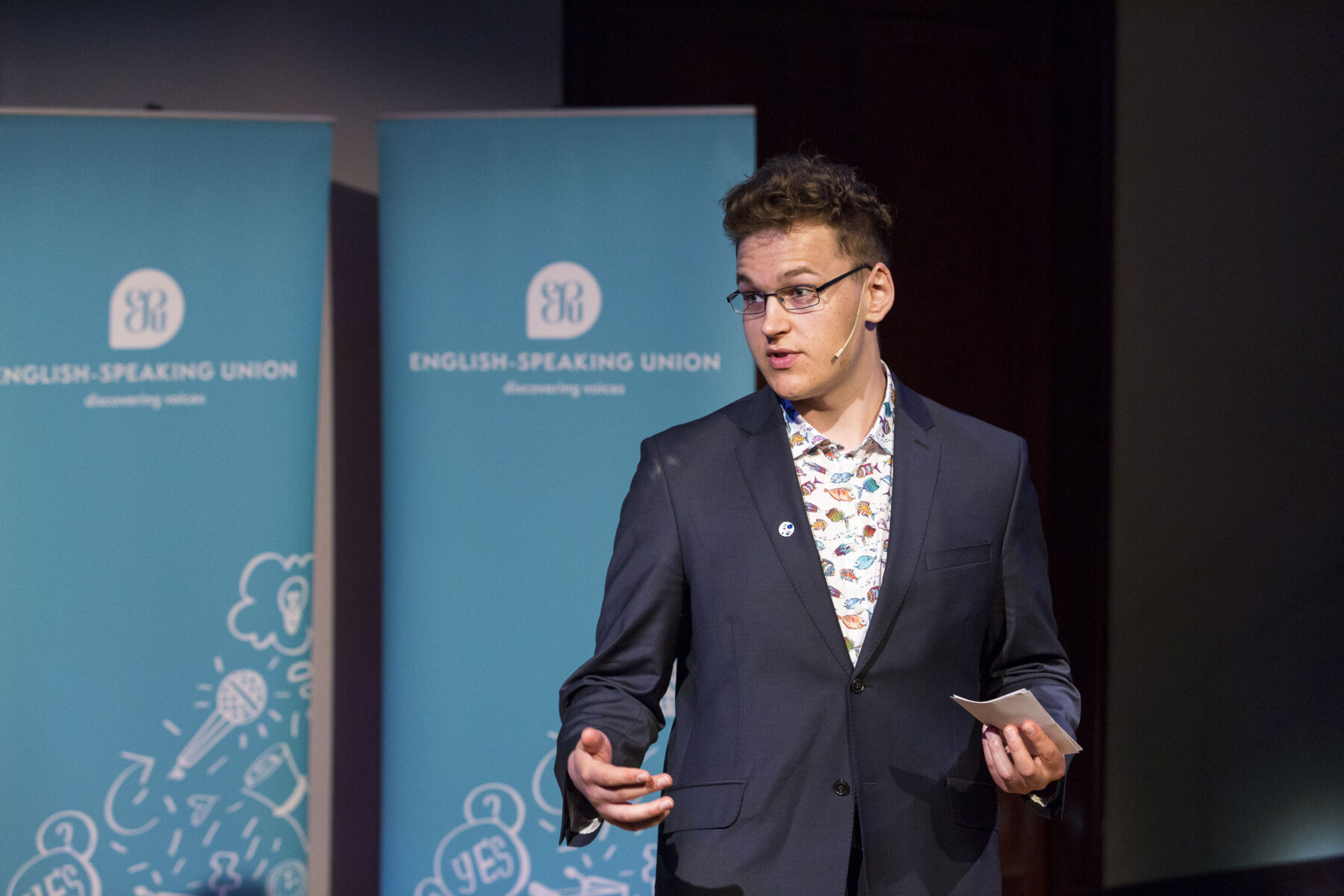
In May 2018, 19-year-old Estonian Markus Aksli took to the floor at the Royal Institution as one of the grand finalists in the ESU’s International Public Speaking Competition. The winner of his country’s national final, Markus had arrived – along with dozens of other national winners – in London a week earlier for an intense few days of public speaking training, heats and cultural visits.
A niggling feeling
Now, he was one of the remaining six, and hoping to win top spot with his speech on the importance of discussing difficult issues openly. As you might imagine, the bar at this stage is very high and, by anyone’s standards, Markus’s speech was slick and compellingly delivered. He didn’t win – that honour went to Johanne Jazmin Tan Jabines from the Philippines– but instead of feeling proud that he’d got so far, he had a niggling feeling that he’d done something wrong.
‘For a while, I just assumed that it was because I hadn’t won,’ he says. ‘But as time went on, I realised that it was something else entirely. I admitted to myself that I hadn’t done that much research into the topic – I’d just watched some YouTube videos. I’d never really tried to argue against myself or to convince myself that I was wrong. I was more focused on crafting a convincing-sounding speech rather than one I felt strongly about. That’s why I think that not winning the IPSC is the best thing that has happened to me. If I’d won, I would have been rewarded for presentation and the trappings of technique – and would never have realised that the real prize is something quite different.
‘Public speaking is all about expressing yourself – but the real dilemma is choosing which version of you to express. Public speaking also happens to be a nightmarish combination of performance pressure, social risk and a raw test of likability and character, rendering it terrifying for most people. Compound this with the sting of losing, and it’s no wonder the easier path is to polish the surface. You can try to play to the judges, defend yourself from being seen as boring or rigid or stupid or pretentious – all for the low price of expressing something you might not fundamentally believe, or that you understand in a slightly false way. You can self-deprecate, massage every syllable and pause, and obsess over the perception of others rather than what you can give them.
Working out what matters
‘But external validation will only get you so far. For internal validation – to feel as if you’re being true to yourself – you need to take the harder path. You need to really think. You need to read and research thoroughly, putting in the work and presence of mind required to figure out what really matters to you, and pinning down what exactly you think is true and important enough for someone to hear. It also means seriously questioning your assumptions and considering whether you could be wrong. It means distilling the core of what you now believe into the short time you’re given and delivering it honestly. What I realised is that I’d taken the easier path. I’d failed to properly exploit the opportunity to think seriously about a subject I care about, and I deprived the audience of what could have resulted from that.
A valuable skill
‘Through the IPSC and my reflections afterwards, I’ve learnt that there’s a lot to be said for paying attention to something for 30 minutes rather than 30 seconds, despite everything modern life does to prevent this. There’s something redemptive about thinking hard about an issue, figuring out what’s true, and how you can best convey that to other people. I find writing my thoughts helps me to clarify them, and this is a process that works as well for writing a speech as it does for navigating life. These days, I write whenever anything complicated or heavy comes up (more often than 19-year-old me could have ever imagined). As a skill, it’s as fundamental as it gets, but you only learn it if you have your priorities straight.
‘My experience of my high school in Estonia was that it was a sort of shark tank, where showing any kind of interest towards anything would see you attacked unless you self-deprecated first. So it was such a life-altering and affirming experience to go to London for the IPSC final and meet all these people at the opposite end of the spectrum – people who were very open, who liked thinking about stuff, and who were interested in listening to what others have to say. I realised that, for me, that’s where the real value of public speaking lies. In working out what you think, you work out what matters to you – and in saying it honestly and effectively, you might just spark a real moment of human connection.’