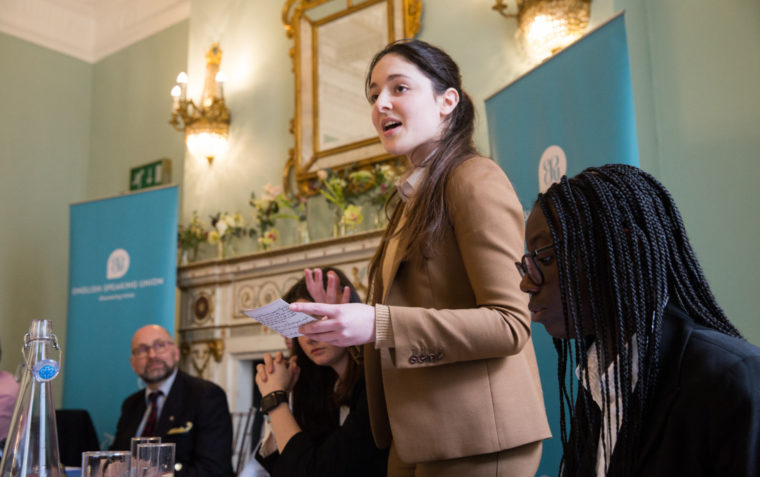

Take a look at the opening arguments in one of the debates from the Schools’ Mace finals 2025
PROPOSITION: (St Aidan’s Church of England high School, Harrogate)
Good morning, I’m Elena, this is Seth and this is Futura. We are proposing the motion ‘this house believes the UK should legalise the use of gene-edited embryos in pregnancy’. So, the motion talks about gene editing, but what is that? We’ve taken a definition from the National Human Genome Research Institute, which defines genome editing as a method that enables scientists to alter the DNA of organisms. So, ‘gene-edited embryos’ refers to embryos that have undergone genetic modification to alter their DNA, usually using a technology called CRISPR. It is also worth mentioning that the modification process happens in a lab before the embryo is implanted into the uterus.
In terms of this motion, I’d also like to remind you that we are not suggesting a sudden, unrestricted legalisation of gene-edited embryos worldwide. We are simply arguing that whilst staying within the laws of UK regulation, we have an opportunity to change the lives of millions of people, and we cannot afford to ignore it. Gene-editing is not about creating ‘designer -babies’. It is about improving quality of life and preventing suffering. To help you see why this is incontrovertibly the case, I am going to start by presenting the benefits of gene-edited embryos. Firstly, the eradication of disease then money-saving. My teammate Seth will expand on our case by demonstrating why these benefits vastly outweigh the objections. He will also address the negatives for the UK of not legalising it. Futura will then summarise and answer any questions from the floor.
According to the NHS, over 3.5 million people suffer from genetic diseases in the UK. They spend their life – which is often shortened by their disease anyway- attending hospital appointments, taking medication, battling with various medical devices, suffering, longing for a cure. And this leads me to my first point. Allowing embryos to be genetically modified can prevent genetic diseases from being passed on from one generation to the next. In fact it can do more than that, tools like CRISPR can actually eradicate genetic diseases completely. Let me give you an example. Huntington’s disease is a fatal, inherited brain disorder caused by a single faulty gene. If just one parent has it, their child has a 50 per cent chance of inheriting it. There’s no cure, and symptoms like memory loss, mood swings, and loss of motor control usually show up in mid-life and lead to death.
But here’s where gene-editing comes in. Using tools like CRISPR, scientists can precisely target the mutated gene in an embryo and either correct it or turn it off – before the child is even born. That means the disease never develops, and crucially, it is not passed on thus eradicating the possibility of future generations inheriting the disease. To help me explain this further, I’d like to give you a real-life example. I’ve got a friend Chloe and she found out recently that she has the gene for Huntington’s. Given that we have the technology, surely she deserves the opportunity to have children without the condition and prevent any of her future grandchildren from facing the same moral dilemma that she is forced to deal with. Huntington’s is the perfect example of why gene-editing in embryos should be legal – it allows us to eliminate a cruel disease permanently and protect families from generations of suffering. How can you object to that?
Not only would legalising gene-edited embryos reduce human suffering, but it would also save money. Let’s take the genetic condition of cystic fibrosis as an example. According to the cystic fibrosis trust, the lifetime cost of treating a single person with cystic fibrosis in the UK is £1 million. By preventing genetic conditions before birth through precise gene-editing, we can eliminate the need for this ongoing care and treatment. The upfront investment in gene-editing technology would be more than offset by the long-term savings in healthcare costs. Instead of spending billions managing diseases, it is the government’s obligation to invest in a healthier future from the very beginning. Preventing disease is cheaper than treating it for life and that is why this motion must stand!
Before closing, I’d like to make it clear that gene-editing is not a hypothetical, futuristic ideal. This is a tangible, life-changing technology that must be utilised and remember it is only through legalisation that we can carry out regulated research and make even more scientific progress. Is it not our moral obligation and the obligation of the UK government to save lives? Is it not our moral obligation to give parents the ability to protect their child from suffering? I urge you to remember this when listening to the opposition’s arguments.
In closing, I have demonstrated convincingly that the use of gene-editing in embryos is a necessity for the future. It prevents suffering and it saves money. What more could you want! But Seth will build upon our case further demonstrating that the UK should undoubtedly legalise the use of gene-edited embryos in pregnancy.
OPPOSITION: (Benenden School, Kent)
Good morning. My name is Claudia and I would like to begin by inviting you to reflect upon this question: would you trust today’s society — with its inequalities, political pressures, and scientific uncertainties — to be responsible for permanently rewriting humanity’s future? Modern medical ethics is rooted in four key principles:
- The preservation of patient autonomy
- Non-maleficence, so doing no harm
- Beneficence, so to what extent is this actually going to help people?
- And finally, justice
This morning the proposition has painted a damning picture of our current medical landscape with the prevalence of devastating genetic diseases such as cystic fibrosis and Huntington’s. A landscape which may lead treatments such as this to appear vital. Yet the proposition’s blanket idealism disregards the fundamental fact that these practices remain incompatible with medicine’s central ethical principles. I will be arguing three substantive points:
- On the plethora of increasingly effective medical alternatives
- The clear inequality in access that shall emerge
- And the inevitable stigma this shall build surrounding individuals with disabilities
My partner will then argue on the incompatibility of this motion on patient autonomy and non-maleficence, leading to our conclusion that this proposal is not only obsolete but ethically and economically unjustifiable.
Arguments on the use of medical alternatives
The proposition has already argued how this motion is fundamentally about curing diseases and preventing suffering, a desire which the opposition supports. However, it is this desire which leads us to highlight the vast range of effective and ethical alternatives, such as pre-implantation genetic testing and somatic gene therapy. Because legalising genetic editing of embryos when safer alternatives exist is neither noble or bold – it is reckless and unnecessary.
Somatic gene therapy targets cells in individuals later in life. It is legalised and regulated, allowing us to treat and prevent genetic diseases without gambling with the human gene pool. It takes place with informed consent, and risks are contained, managed, and weighed directly by the patient. It can cure diseases like sickle cell – but it does not violate non-maleficence, because it targets non-reproductive cells, meaning that any possible effects are confined to one person.
We should not attempt to run before we can walk — and in this case, walking carefully with somatic gene therapy is the only ethically defensible choice, and far more economically sustainable. This moves me on to my next point:
Socio-economic inequalities
Central to the proposition’s arguments are the alleged promotion of health equity, because of course everyone should be able to ensure their child’s health. Nevertheless, the proposition’s argument is built upon aspiration not realism. This technology will be prohibitively expensive, especially in its early stages, and will ultimately widen gaps between those who can afford ‘healthier babies’ and those who can’t. For example, one round of gene-editing is projected to cost between $1 and 2 million, which equates to around 70 rounds of chemotherapy on the NHS.
Given the NHS is highly stretched for funding, and given the clear ethical uncertainty surrounding the treatment, we may conclude that the NHS will not be able to be the sole provider of these services, indeed we predict it will almost exclusively be distributed amongst private clinics. Thus, legalising embryo editing doesn’t solve health inequality, but shifts investment away from broad, public-health solutions to niche, ambiguous procedures only afforded by the ultra- elite. This doesn’t solve inequality – it institutionalises it at the genetic level.
It is therefore clear that the legalisation of the use of gene-edited embryos for pregnancy, fails to preserve the central notion of justice and therefore remains practically, ethically and economically unimplementable.
So therefore finally, on to my third point, how this may lead to:
The stigmatisation of genetic illnesses
The proposition upsettingly shies away from the damaging precedents these treatments set. If the motion is aiming to provide a solution for severe illnesses and disabilities, we must begin to ask the questions: What shall count as a disease worthy or serious enough for treatment? Would deafness? Short stature? Low IQ? Individuals with autism and other neurodiversities such as ADHD and dyslexia?
Social pressures may make this line impossible to enforce once crossed, paving the way for a Brave New World of a genetically edited elite and designer babies, particularly if this is placed in the hands of private practitioners. Once you make gene-edited embryos legal, market and social pressures will inevitably push the boundaries and the proposition therefore implicitly endorses a value system where the lives of those born with impairments are less worth living. Once we say, ‘this embryo is not good enough’, we risk promoting ableism, perfectionism, and genetic determinism. Fundamentally editing DNA to eliminate difference is eugenics by another name.
Conclusion
We believe legalising gene-edited embryos is not just a matter of science – it’s a matter of what kind of society we want to build. Do we want a society where children are edited to order? Where wealth buys biology? Where we open doors we can never ethically close? We stand for a future guided by precaution, equality and human dignity in medicine both at home and globally. Ladies and gentlemen, I urge you to side with the opposition this morning.
*This is an edited extract of arguments made at the Schools’ Mace debating competition 2025