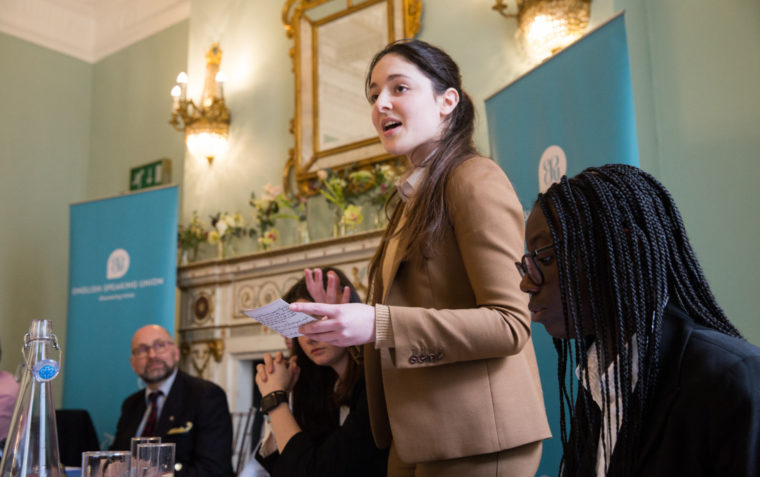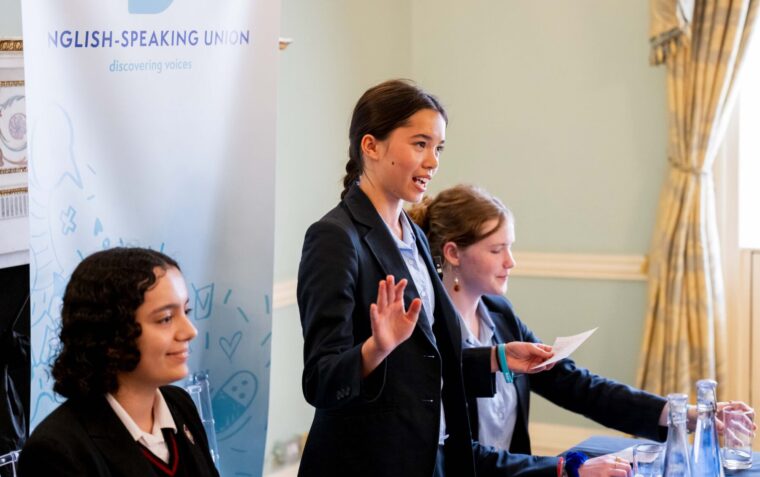

ESU alumnus and university student Saim Khan tells us what he got out of our ESU Schools’ Mace Debating Competition and why he signed up as a volunteer judge
When did you first hear about the ESU?
It was while I was at school (at Queen Elizabeth’s in High Barnet). I’d done some house debating in Years 7 and 8 and really enjoyed it but then Covid hit and everything sort of stopped or went online. Then, in Year 11, a new teacher took over the debate club and introduced us to the ESU Schools’ Mace.
How did you prepare for the Mace?
We had a core team of five and would swap different people in and out in the different heats so that everyone got a chance to speak. We worked with the wider debate club too, w here other people would chip in to help with research for example, which was a really nice way to get lots of people involved.
How far did you get?
I took part in the competition for three years, in Year 11, 12 and 13. The first couple of years, we got through round one and unfortunately we were knocked out in round two. And so, by the time I was in Year 13, I was like, ‘come on guys, it’s my final shot at this. I’m getting old; let’s try to go all the way’. And thankfully we made it to the semi-finals at Dartmouth House!
What did you get out of the competition?
A few things. Firstly, I think it encourages you to think quite deeply into issues which you may not have thought about to that level before. One of my favourite motions was that all music should be free to listen to, with no copyright. I do listen to a lot of music, but, you know, I’d never actually thought much about the legalities behind it before. And I remember really enjoying the research because I was finding out about interesting legal cases and music theory and chord progressions and to what extent they can be copyrighted. It was fascinating, and that was repeated with many of the topics we debated. Secondly, the oracy angle – being able to stand up and feel like you have earned the right to talk about something for seven minutes, and for people to listen. And then, when they ask you questions and you answer them in a summary speech, you realise that people are genuinely curious about what you have to say. And thirdly, it is nice to visit other schools, travel a bit and meet new people and make friends, realising that you all share a love for debate. I really enjoyed that as well.
When and why did you decide to volunteer for the ESU?
I’d decided, subconsciously at least, during my final year of doing the Mace. We’d broken our glass ceiling and made it through to the semi-finals and, although I was very happy, I realised I was approaching the end of my journey as a speaker in the competition. I remember saying to one of my friends, wouldn’t it be fun if we started judging? The more conscious decision came a few months later when I’d started uni [Imperial College, London] and had attended a session or two of my uni debate club. Even though I’m studying maths, I realised that I still wanted to spend time on this activity. I really enjoy it. I have very fond memories of the Mace and of the ESU and I just thought, why not give back some of my time?
What do you enjoy most about judging?
It’s genuinely inspiring, seeing these young people who have clearly spent a long time researching their subjects – which are often very interesting, topical issues – and practising and honing their arguments and presentation. So I enjoy that, but I also enjoy the feedback and learning process. I know from my own experiences that the judges who understood where we could improve and who could explain where our weaknesses were, were always the most helpful. It’s always less painful to lose when you understand exactly where you could have improved. And so now that I’m in a position where I’ve done a bit more debating, I find it really enjoyable giving that feedback to people who are very interested and engaged.
Have you met other volunteers while doing this?
I have. I persuaded one of my uni friends who had also done debating at school to volunteer with the ESU and we have judged together a couple of times which was fun. And there are other judges who I’ve seen a few times so you do form a community of volunteers, which is nice.
And are there any particular students or schools or heats that have really stood out for you?
There have been a lot of individual students who stand out but one school which really sticks in my mind is South Hampstead High School. Their heat was online, which can be quite draining, quite taxing, for speakers and judges alike. And I remember that both of the speakers for SHHS were just so enthusiastic, energetic and charismatic. They really made you want to listen, which I thought was quite an achievement.
What difference do you hope you are making by doing this?
I want it to be less intimidating to debate. I think one of the big issues is that there is a perception around debating as something which is for people who love talking in front of others or who are massively extroverted. And while that is part of it, I think that debating has a far lower barrier to entry than a lot of people think. It’s true that later rounds of many competitions are often comprised of people from private schools, but there are so many online workshops for different debate styles and techniques that not having a dedicated coach needn’t be an issue.
I hope that by providing good quality judging and good quality feedback, I can make debating less intimidating, and something which people feel that they can be part of and engage with more. I also hope that I can spread enthusiasm for the activity in and of itself. I think sometimes, people do debating because it has practical value on CVs, but debating has so much more to give.
I can play football because it might help me keep fit, sure, but I can also play football because I really enjoy football and I enjoy the team and I enjoy spending Sundays with my friends there. And it’s just the same with debating! There are lots of different reasons that people debate. You might be really into research, or want to find out new things about the world, or maybe you just want to go meet new people and travel a bit around your local area. I would just encourage many people as possible to try it. Worst case scenario, you may not enjoy it so much, and that’s fine. But I think that it’s definitely something everyone should try at least once.