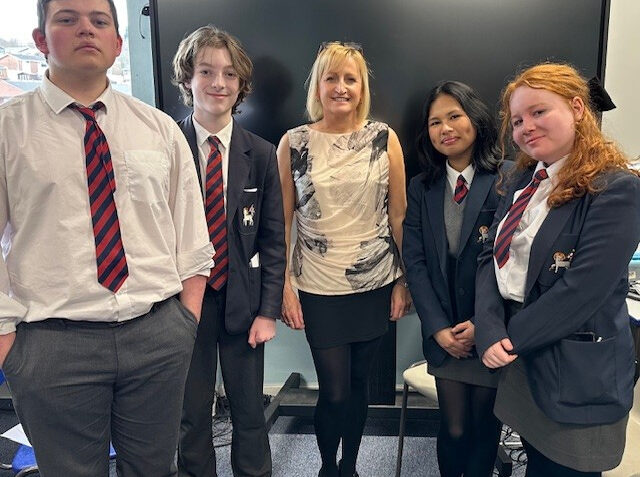
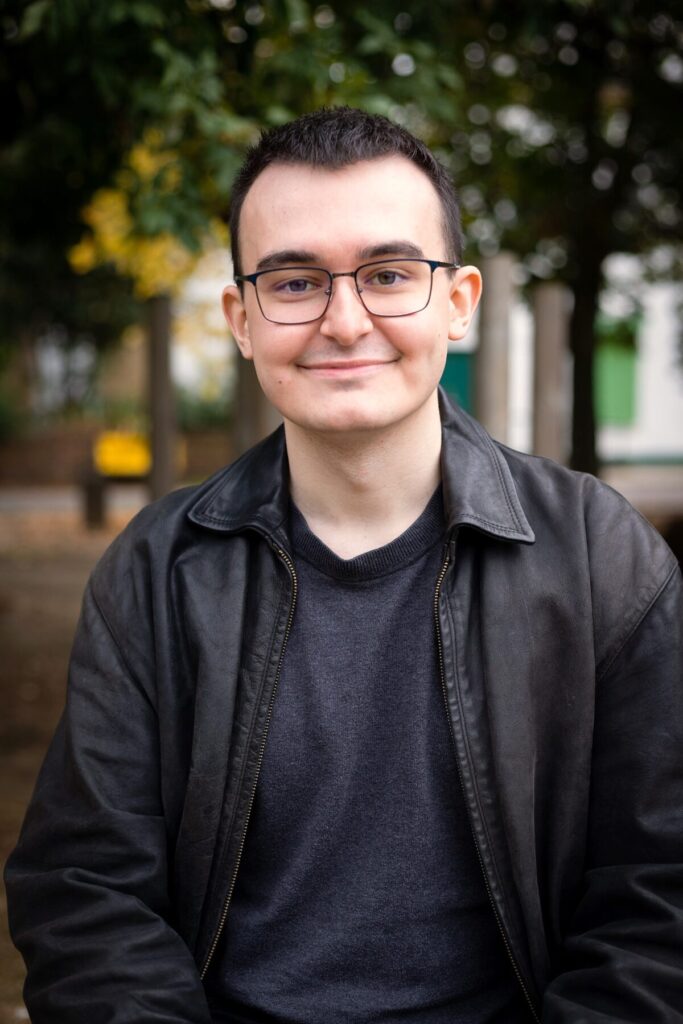
George-Håkon Benson, Director of Debating and Public Speaking at City of London School for Girls, tells us why he brought his Year 7 & 8 students to watch the Grand Final of our International Public Speaking Competition 2025
When George-Håkon Benson was appointed Director of Debating and Public Speaking at City of London School for Girls in 2024, he had one mission. ‘We want to improve the culture of oracy and public speaking in our school. We’re trying to make it cool,’ he says. ‘Sport is seen as cool. And there’s a romanticism to music or drama that debating and public speaking don’t quite have. But we want to show our girls that public speaking can be every bit as aspirational and prestigious, and that’s why we’re here today.’
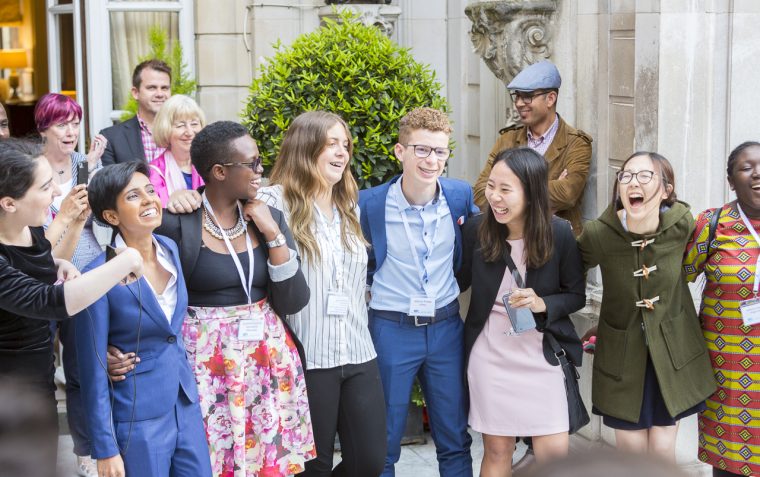
It is in fact George-Håkon’s second time at the Royal Institution, where the Grand Final of our International Public Speaking Competition (IPSC) is held, ‘so I knew we’d be in for a treat,’ he smiles. ‘Last year, the students – a group of Year 7s – were so inspired that they were biting my hand off to do more public speaking.’ With only six spots available in the ESU’s Public Speaking Competition [PSC], he has had to create an entirely new in-house competition to satisfy demand. ‘To come to a venue like this and to see students not much older than themselves holding the floor really gets them going. They love the fact that the students come from all over the world too – the girls were going through the list going ‘Mauritius! Mongolia! Uganda! – they realise the competition is much, much bigger, and that what we’re seeing today is the very pinnacle of the performances.’
Though George-Håkon did not do the PSC as a student himself, his school – Central Foundation Boys’ School in Old Street – did prioritise oracy, and he counts himself lucky to have spent a week at the ESU’s Debate Academy, aged 17. ‘All my friends went the summer before, and I had the biggest FOMO of my life because they loved it,’ he laughs. When he eventually went the following year, he had ‘a fantastic time’, so much so that he has more recently gone back to teach there, as well as working as a competition lead for our Schools’ Mace debating competition, the PSC and our Discover Your Voice Workshops. ‘And now that I’m a teacher, I know how good this stuff is – of course I’m going to get my students in on it.’
He enters his students into two of our competitions – the Schools’ Mace and the Public Speaking Competition – and is clear on the benefits they bring. ‘Oracy is everything,’ he says. ‘I think oracy is critical and fundamental to every objective a school has. Even if you think about school in the most reductive terms possible – ie that its only purpose is academic progress – then oracy is key. There’s plenty of research evidence showing that students who take part in oracy interventions achieve higher attainment. If you improve students’ speaking and listening skills, they are better able to understand the information they’re being taught. They’re better able to articulate what they don’t understand, and better able to ask questions to get teacher help.’
As we all know however, school is about so much more than just results – student well-being being another key principle. ‘Being able to teach students how to accept difference, to disagree constructively, to articulate themselves when they’re frustrated – all stop a huge amount of teenage fallings out,’ George-Håkon continues. ‘Learning to stand up in front of other people without feeling awkward is a key skill too. It helps students feel more confident in and of themselves, which is so important for their mental health, and helps further so many other pastoral goals as well.’
From a careers perspective, too, George-Håkon is convinced that the competitions will help give his students the edge. ‘So many students are now getting As and A-stars and good degrees. To get to the best universities and to get the best jobs, you need to be able to sell yourself. You need to be able to sound like you know what you’re talking about. I’ve worked with so many students who are so, so good at their subject technically, but can’t convey their knowledge and intelligence orally. Getting to go to competitions, like the ESU’s, gives students opportunities to put these skills directly into practice within a pressurised, but still safely-controlled environment – ideal preparation before you need to perform at your best in a stressful and high-stakes university interview, for example.’
Communication skills have long been in demand by employers but, given the rise of AI, George-Håkon feels that they are now more important than ever before. ‘AI is automating both reading and writing, but the one thing it can’t yet do and hopefully will never be able to do, is interpersonal communication,’ he says. ‘So in terms of the key employability skill in future, it’s being able to talk to people. It doesn’t matter if you can write a good essay anymore, or at least that’s not enough on its own. You need to have the communication skills and teamwork to back it up.’
Few people would disagree with the above, and yet oracy still gets precious little attention in the curriculum and far, far less than other staples such as English or maths. It follows then that schools should provide opportunities for students to learn and practice these skills, just as they do spelling and multiplication. ‘I think that fundamentally, schools exist to provide students opportunities that they don’t get at home,’ says George-Håkon. ‘And increasingly, children are sat at home on their iPads and communicating digitally. People worry about political polarisation, but I think it goes far deeper than that. The way in which we engage in discourse isn’t interpersonal anymore, which means that even if people wanted to disagree constructively, they don’t necessarily have that skill or experience.’ In this light of course, schools assume an even more important role. ‘Schools provide an opportunity – perhaps the only opportunity – where you can get students in a classroom and make them talk and build that skill,’ says George-Håkon. ‘They might not love it, at first, but it’s imperative that they learn it.’
And of course, just as with English and maths, many students do indeed love it – especially when they get to come to events like the IPSC. ‘It’s just been wonderful,’ says Emily in Year 8. ‘There are people here from all over the world and they actually come up to you because they want to speak to you about their ideas and they’re willing to engage with your perspectives on what they’re thinking. Also, it’s almost like a window into the future because you think where you are now – I do some debate at school – and you can put that into context because you can see where public speaking can take you in just a few years.’