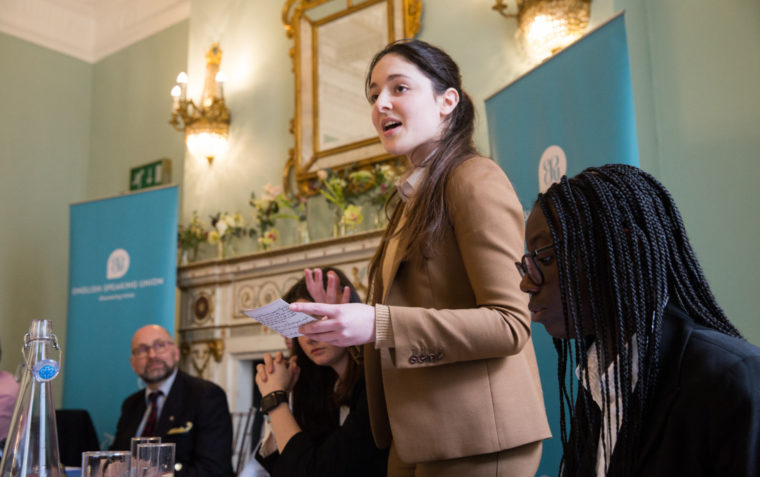

Geoff Barton, former English teacher, headteacher and Chair of the Commission on Oracy Education shares his tried-and-tested tips on how to make debating work in your school
Make it regular & make it fun
Beyond the classroom, any debate club or society (we used to call it ‘rowing club’ when I was a head of English in York, because the linguistic ambiguity amused me!) needs to have a regularity to it to get any momentum behind it. Make it informal, have refreshments and you’ll find that even those students who come for the biscuits may end up staying because they like the crunchy arguments as well.
Make it belong to your students
By all means you can set the motions – either by announcing them the week before so that students have some time to think, or simply by allowing students to pull one out of a hat on the day – but appoint students to be the chair and the judges. It gives a sense of ownership and extends the skillsets and learning experience. Some youngsters might not be very good debaters – some of them might never even try debating – but they might be extraordinarily accomplished chairs and judges. And those listening, social, analytical and leadership skills are every bit as important.
Make it matter at a senior level
With the recent news about the inclusion of oracy in the Ofsted Inspection Toolkit (it shows up as a foundational part of key stage 3), plus the greater emphasis being placed upon speaking and listening across the revised national curriculum, this should become a lot easier over the next few years. But it’s still very helpful for all staff, particularly the senior leadership team, to understand why debating matters. Take your students into a governors’ meeting to give a short demonstration. If they’ve been to a competition at the weekend, take them into the Monday morning staff meeting so they can talk about how it went, the motions they had and what they learnt from it. As well as spreading the word about debating among the leadership, you’re giving students valuable opportunities to access places and spaces they wouldn’t otherwise go.
Make it visible in the school
I always liked to have displays around the school so people would know where to find the motion that we’d be debating that week (and reminding students that there would be biscuits there). I also recorded every debate and posted it on the website – but that’s because, as a failed DJ, I love playing with audio. This allowed the students to listen back to themselves, and for others to hear what we got up to but, just as importantly, it was another subtle way of saying ‘this stuff matters’.
Take part in competitions
Going to local competitions and, later, the larger ones like the ESU, Cambridge Schools, Oxford School, Durham, was a very significant part of what we did. It was part of the routine building, of what we did on some evenings and on some weekends. It allowed us to tell a story to senior leaders and governors that we didn’t just ‘do’ debating – we competed against some of the top debating teams in the country. Having to speak in an unfamiliar environment in front of people you don’t know can be mortifying, but it really helped to give a sense of confidence to our state comprehensive school that we could do this stuff as well. And of course, as you start progressing in competitions, it begins to build a momentum of its own.
Have a debating assembly
Twice a term at King Edward’s, we’d have a debating assembly with every year group, because I wanted young people at, say, 14 to see that other young people of their age could stand up and speak in public about a controversial topic. Sometimes, I’d ask the audience to pick a motion and the speakers would only have 30 seconds to prepare. For youngsters in the audience who were terrified of speaking to see people in their peer group being able to do that was extraordinarily motivating. Some students would then be inspired to ask a point of information – a little taster of debating, which could lead them to come and join the weekly after-school debate. And again, the assembly debates showed the onlooking school staff what students are capable of.
Bring it into tutor time
Debating doesn’t have to be formal. There’ll always be something topical in the news that you can have a conversation about. In tutor time, I’d ask students to discuss their opinions in pairs and to rehearse their three main points, and then pick a couple to report back. It helps get that debating culture into the school a bit more, and connects tutor time with some of the controversies swirling around in the news.
Develop a culture of leadership
The youngsters who were doing debating with me were gaining confidence and a taste for roles in public life because they were being given opportunities outside the classroom which helped them. All of them – those chairing and those judging as well as the speakers – were deeper, more critical thinkers, and understood how to make and deliver a compelling argument, all skills which will set them up well for the future.