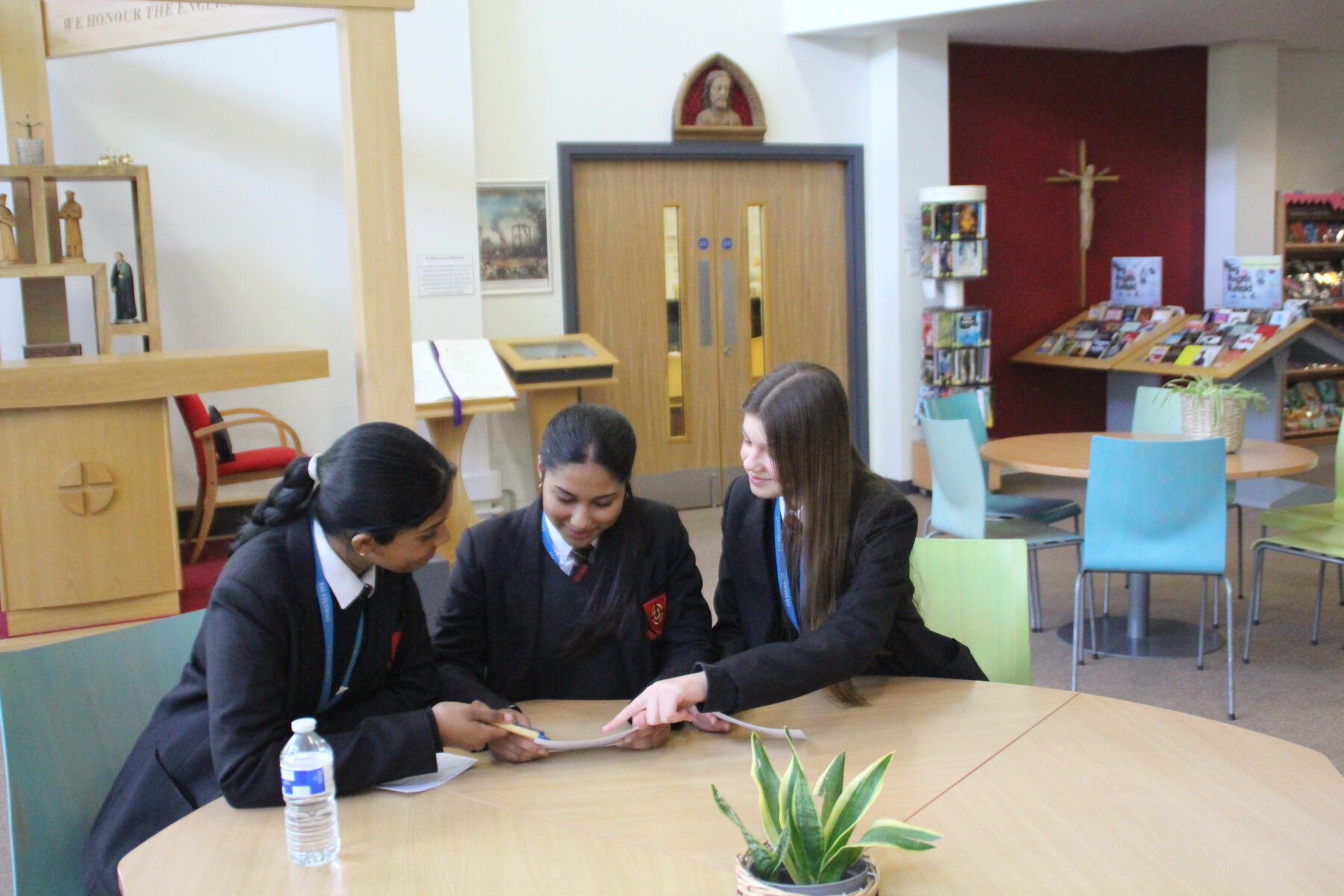
Three students from English Martyrs’ Catholic School in Leicester reached the regional finals of the ESU Public Speaking Competition this year, a remarkable achievement for first-time entrants. We spoke to Debria, Aalish and Marta, and their teacher Deborah Fones, about what they got out of the experience.
For Debria, Aalish and Marta, taking part in the ESU Public Speaking Competition was a step into the unknown. None of them had done anything like it before. Yet, in their first year, the team progressed all the way to the regional finals.
‘It helped my confidence a lot,’ Debria reflects. ‘As a chair, you have to be very welcoming and warm. It made me more confident speaking in front of people.’
Each role in the competition brought its own challenge. For Aalish, acting as questioner meant thinking on her feet: ‘You can prepare questions, but you’re hearing the speech for the first time. You have to respond in the moment and think about how to follow up.’
For Marta, the experience was about finding her voice. ‘I hadn’t really made a lot of speeches before,’ she explains. ‘This helped me practise projecting my voice and to understand how to present a good speech.’
Learning through action
Preparation looked different for each of them. From watching past performances to practising with flashcards and learning from older students, the team developed their own approaches.
‘I looked at examples, but then wrote everything myself and made it sound like me,’ says Debria.
Marta credits support from a previous competitor as instrumental: ‘She helped me prepare my speech and practise it; it made a big difference.’
Crucially, the competition didn’t just build skills for the day itself. The students are already applying what they’ve learned elsewhere by supporting peers with debate preparation and using feedback to improve their own speaking.
‘One of the biggest things was learning not to rely too much on notes,’ says Debria. ‘Next time I want to practise more so I can speak more naturally.’
Aalish agrees: ‘For me, it was about involving the audience more and projecting my voice. That’s something I’ll definitely work on.’
Confidence that carries forward
Teacher Deborah Fones has spent the past two years embedding speaking and listening across subjects, recognising its importance not just in English, but across the curriculum.
‘Oracy is central to what we do,’ she explains. ‘We’re seeing more students standing up, discussing ideas, presenting their thinking and growing in confidence as a result.’
Competitions like the ESU Public Speaking Competition play a key role in that journey, especially given the quality of feedback students receive.
‘The judges are perceptive and gracious,’ she says. ‘They point out what needs improving, but in a way that builds students up rather than knocking them down. That’s so important, especially for young people who are just starting to find their voice.’
That supportive environment helps students push past initial nerves and, in some cases, rethink what they’re capable of.
‘After the regional finals, they were disappointed at first,’ Deborah admits. ‘But then it quickly turned into, “Can we do it again next year?” That’s what you want, they’ve caught the bug.’
Breaking down barriers
For schools like English Martyrs’, competitions also provide something less tangible but equally important: exposure.
‘There can be a perception that this is just for private schools,’ Deborah says. ‘But it’s not. And when our students take part, they realise they can stand alongside anyone.’
That realisation can be transformative. Students not only develop speaking skills, but also a sense of belonging and ambition that extends far beyond the competition itself.
‘They learn that everyone gets nervous, everyone makes mistakes, and that doesn’t mean you’ve failed,’ Deborah adds. ‘It builds a quiet assurance. And that stays with them.’
‘Just go for it’
All three students say they would recommend the experience to others, and are already planning to take part again.
‘Definitely,’ says Marta. ‘It’s really worth it.’