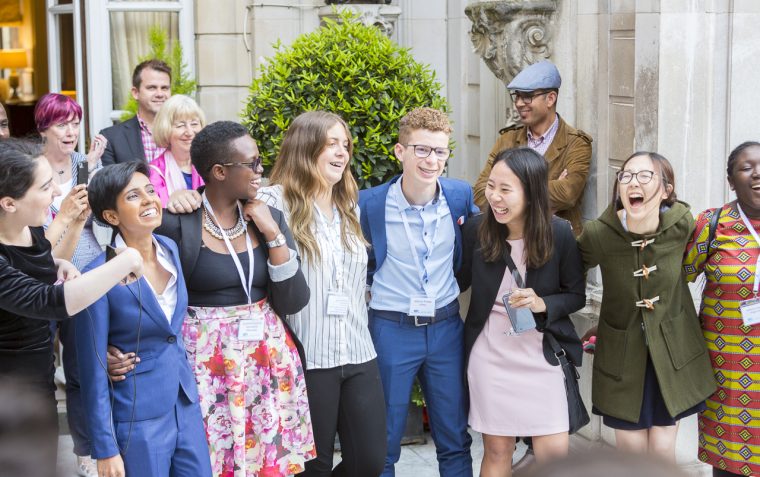


In May 2025, 17-year-old Saesha Goyal from Pune, India, took to the stage of the Royal Institution in London as one of six grand finalists in the International Public Speaking Competition. Following a week of cultural exchange and two competitive semi-final rounds, Saesha emerged as one of three runners-up.
However, for Saesha, ‘It wasn’t about winning, it was about the experience. Even if I hadn’t made it to the finals, I would’ve been just as happy. The IPSC genuinely changed me as a person, and you wouldn’t think one week could do that. It sounds idealistic, but all of us are living proof that it did.’
Saesha has attended the Convent of Saint Mary the Virgin (a private school in Pune) for her entire life, where she first discovered a love for the spoken word. Though she had made her mark nationally in school debate competitions, public speaking wasn’t something she had seriously considered until her English teacher approached her about the IPSC.
‘Debate had always been my thing, but this was different. It was about telling a story, about reaching people. That challenge intrigued me,’ she says.
Encouraged to apply, Saesha soon found herself immersed in a rigorous, months-long preparation process. She received feedback on her speeches via email from a family contact and refined her delivery through twice-weekly sessions with her teacher and national coordinator, Avanti. Throughout it all, she regularly discussed topics and ideas with her mum – something the two of them enjoyed and bonded over. Saesha even practised her performance while on a family holiday in Italy.
‘We were worried the trip might throw me off, but instead it became part of my prep,’ she says. ‘We gathered small groups of tourists in Italy and I delivered my speech to them to see if they could understand my accent.’
Saesha’s IPSC journey extended well beyond the grand final stage. In both her preparation and during the competition week itself, she was exposed to voices and viewpoints from every corner of the world. ‘I’d been in plenty of rooms with smart people before, but never one like this where everyone brought such different cultural perspectives. It pushed me to think in ways I hadn’t before.’
The bonds forged during that week were more than fleeting. ‘That week changed how I see the world,’ says Saesha. ‘We weren’t just sharing speeches; we were exchanging world views.’ As proof of the lasting impact of the week, Saesha continues to quote lines from her fellow participants in her own speeches, saying, ‘My friend from Lithuania once said…’ or ‘My friend from Brazil shared this thought…’
While her confidence as a speaker grew, Saesha says the biggest skill she took away from IPSC wasn’t speaking, it was listening. ‘Listening to understand, not just to respond, is something I learned at IPSC. And it’s rare, especially for young people today. We talk a lot, but we don’t always slow down to really hear each other. This competition gave me that awareness.’
This perspective aligns with Saesha’s long-term goals, both personally and professionally. Coming from a family deeply rooted in the real estate sector, she has always envisioned expanding the business on a global scale and believes that participating in the competition has strengthened that vision. ‘The IPSC gave me the confidence to think globally – not just about business, but about impact.’
While real estate is Saesha’s main focus for now, she’s also interested in working in international relations – perhaps through the UN or global climate conferences – and believes her experience at IPSC will support this alternative path, too.
Looking ahead, Saesha will remain in Pune for her undergraduate studies, allowing her to stay actively involved in her family’s business. However, she has no intention of leaving public speaking behind. ‘I’ve been competing in debates at the high school level so far, but I’m really looking forward to taking that to the next stage at the intercollegiate level, and hopefully even internationally, in college.’
Saesha also sees herself mentoring younger students and encouraging others to apply for the IPSC in future. After all, she’s already given a speech at her school about the life-changing experience: ‘So many students came up to me asking if I recommend international competitions,’ she says, ‘and there’s just one answer: “yes, yes, yes”.’